Without Expanding Evaluate The Following Determinants All Available Content & Media #664
Launch Now without expanding evaluate the following determinants exclusive webcast. On the house on our streaming service. Submerge yourself in a comprehensive repository of documentaries showcased in best resolution, a dream come true for superior viewing devotees. With the newest drops, you’ll always have the latest info. See without expanding evaluate the following determinants themed streaming in life-like picture quality for a truly captivating experience. Become a part of our content portal today to view subscriber-only media with at no cost, no subscription required. Get access to new content all the time and browse a massive selection of indie creator works produced for choice media followers. Seize the opportunity for uncommon recordings—get a quick download! Witness the ultimate without expanding evaluate the following determinants singular artist creations with dynamic picture and editor's choices.
We will use the properties of determinants to evaluate the value of the determinants without expanding Without expanding determinants, find the value of ∣ 1 0 5 7 1 0 7 1 2 1 2 1 5 7 1 5 ∣ Complete step by step solution
Without expanding, evaluate the following determinants. [(1, a, b+c) (1
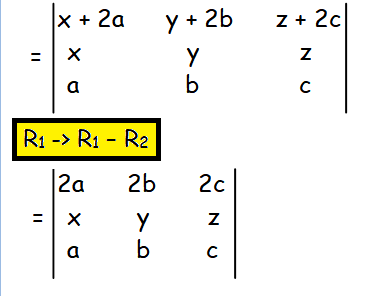
We will use the properties of determinants to evaluate the given determinants If c is the matrix of cofactors of the matrix a, then what is the value of the determinant of c 2 (a) we know that if any two rows or columns of the determinant are added, then the value of the determinant remains the same.
Without expanding, evaluate the following determinants
Factor 3x from the third row In the above determinant, rows 1 and 3 are identical = 3 (0) = 0 so, the value of the given determinant is 0 Add the first and second row and make the result as first row
Without expanding evaluate the following determinant. ∣ 1 𝑎 𝑎 + 𝑐 1 𝑏 𝑐 + 𝑎 1 𝑐 𝑎 + 𝑏 ∣ Evaluate the following determinant without expanding: ∣ 5 5 5 𝑎 𝑏 𝑐 𝑏 + 𝑐 𝑐 + 𝑎 𝑎 + 𝑏 ∣ By using properties of determinant prove that ∣ 𝑥 + 𝑦 𝑦 + 𝑧 𝑧 + 𝑥 𝑧 𝑥 𝑦 1 1 1. Explanation these problems require us to evaluate determinants without expanding them directly, i.e., by using properties of determinants such as row/column operations, factorization, or recognizing patterns. Without expanding evaluate the following determinants | (2,7,65), (3,8,75), (5,9,86)| watch solution without expanding,find the values of the following determinants.
Without expanding evaluate the following determinants | 1 w w2 | | w w2 1 | | w2 1 w | where w is a cube root of unity
Answer by sachi (548) (show source): The question is #653 from golan's linear algebra every graduate student should know and while it doesn't explicitly say not to just expand and factor it, i think that's the spirit of the question Std 11 maths 1 exercise 6.2 solutions commerce maths question 1 (i) \ (\left|\begin {array} {lll} 1 & a & b+c.
Here you can calculate a determinant of a matrix with complex numbers online for free with a very detailed solution Determinant is calculated by reducing a matrix to row echelon form and multiplying its main diagonal elements About the method to calculate a determinant you need to do the following steps Set the matrix (must be square)

The calculator will find the determinant of the matrix (2x2, 3x3, 4x4 etc
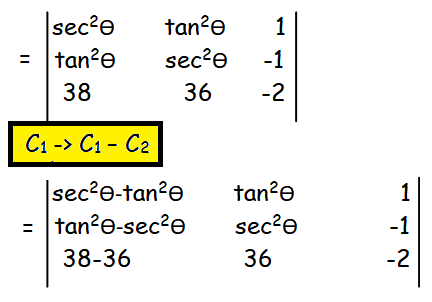
) using the cofactor expansion, with steps shown. Determinant calculation by expanding it on a line or a column, using laplace's formula this page allows to find the determinant of a matrix using row reduction, expansion by minors, or leibniz formula. Each row of the matrix has four consecutive square numbers.* note that column operations preserve the determinant in the same way that row operations do (this is obvious if we recall that the determinant of a matrix equals the determinant of its transpose, and column operations on your matrix are row operations on its transpose). We would like to show you a description here but the site won't allow us.
So the answer is 0 Theorems 3.2.1, 3.2.2 and 3.2.4 illustrate how row operations affect the determinant of a matrix In this section, we look at two examples where row operations are used to find the determinant of a large matrix Recall that when working with large matrices, laplace expansion is effective but timely, as there are many steps involved

This section provides useful tools for an alternative method.
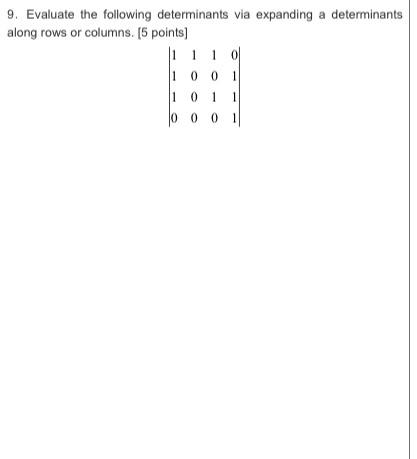
Write the minors and cofactors of each element of the first column of the following matrices and hence evaluate the determinant in each case Prove the following determinant without expanding ask question asked 11 years, 5 months ago modified 11 years, 5 months ago We now obtain an alternative method for evaluating determinants The basic idea is that we can reduce a determinant of order n to a sum of determinants of order n −1
Continuing in this manner, it is possible to express any determinant as a sum of determinants of order 2 This method is the one most frequently used to evaluate a determinant by hand, although the procedure introduced in the. Also calculate matrix products, rank, nullity, row reduction, diagonalization, eigenvalues, eigenvectors. 15,508 views • dec 7, 2020 • 11th std maths ex.7.2 (full) all exercise problems solved

I learnt only adding and subtracting or multiplying rows and columns and i can expand.but the problem asked to prove the determinants are zero without expanding.i can't figure out with these skills.
Without expanding evaluate the following determinant ∣ 1 + 1 + 1 + ∣ the value of the determinant of a matrix a of order 3 is 3

Without Expanding Evaluate The Following Determinants All Available Content & Media #664
Watch Instantly noteworthy without expanding evaluate the following determinants streaming now in brilliant 4K. Fresh videos uploaded regularly & open to all on our digital entertainment center.